
From founder to owner: “You have to be ready to let go”
02 September 2026

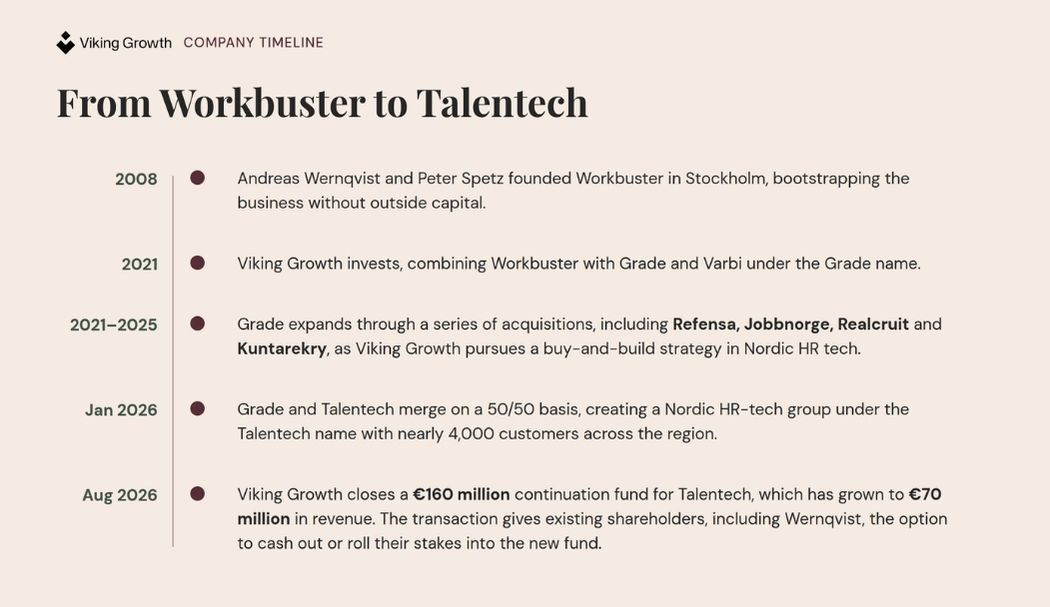
02 September 2026
When Andreas Wernqvist and his co-founder, Peter Spetz, sold the company they had built, they chose to reinvest 50 percent of the proceeds in the new company.
Wernqvist stayed on as Chief Marketing Officer (CMO) for another two and a half years before stepping away from his operational role. Today, he remains involved as a board member and his investment has more than doubled.
His experience has taught him that daring to let go can be one of the most important lessons for founders bringing in new owners.
"Before you sell, be prepared to let go of control and, above all, operational responsibility."
.jpg)
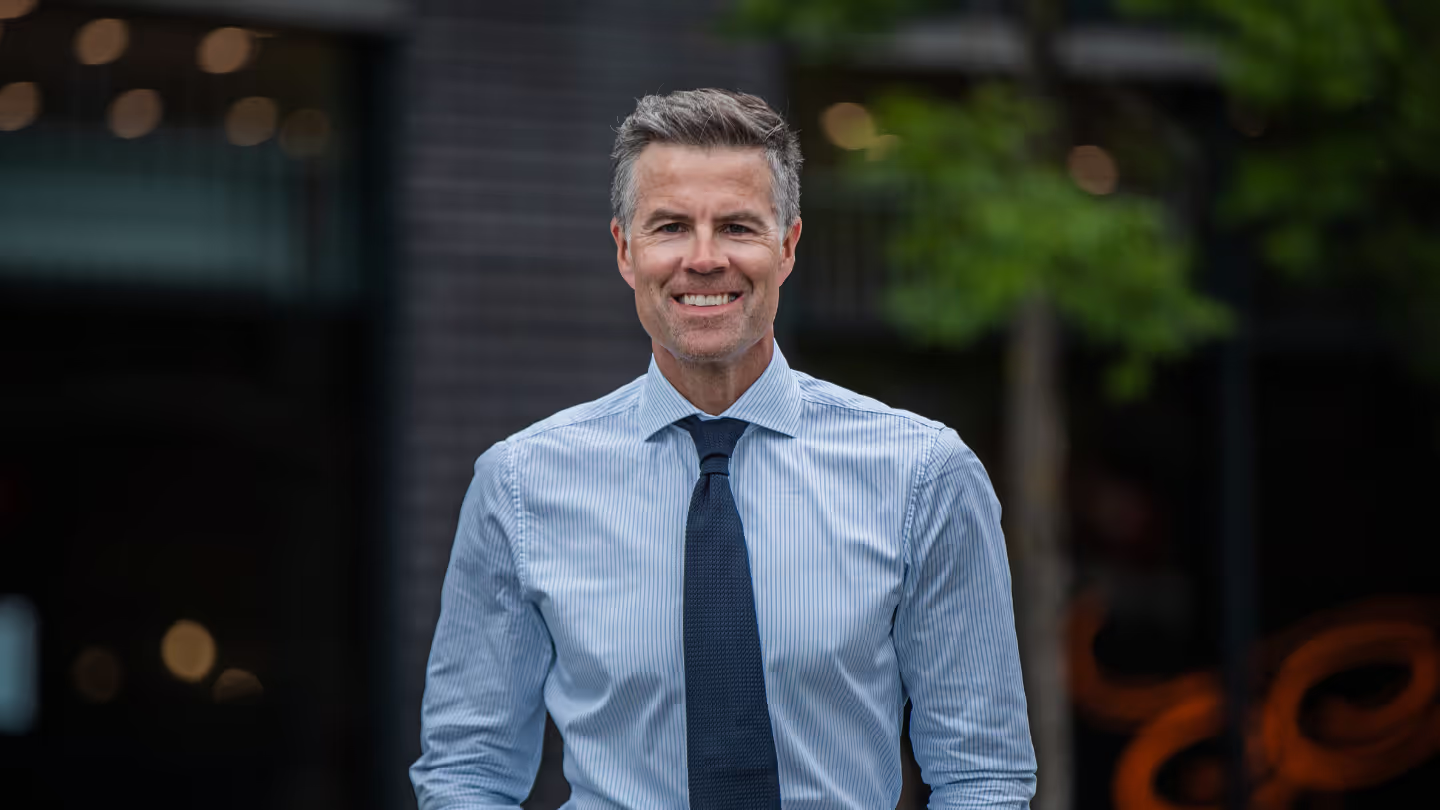
Andreas Wernqvist, Co-founder of Workbuster, owner in Talentech
For many founders, the company becomes closely tied to their identity. They built it from the ground up, took the risks, and were involved in everything from customers and product development to hiring and finances.
This can make it difficult to let someone else take the lead.
For Andreas Wernqvist, daring to do exactly that became an important part of his transition from founder to owner.
Together with his co-founder, he spent several years building the Software-as-a-Service (SaaS) company, Workbuster, using their own funds. Establishing a stable base of recurring revenue took time, and at times they combined building the company with consulting work to finance the business.
“It was tough, but at the same time an incredible journey. We had great customers and incredibly talented employees.”
Eventually, the founders reached a point where they had to ask themselves a difficult question:
Were they still the right people to take the company to the next level?
The answer was not necessarily yes.
“We reached a ceiling. There was more administration, more people management, and we realized there were areas where others could do a better job than us.”
When the company was sold to Viking Growth as part of a merger with Grade and Varbi in 2021, Wernqvist could have cashed out.
Instead, he reinvested 50 percent of his proceeds in the new company.
It was an important decision. Wernqvist retained substantial financial exposure to the company's future development because he believed there was still considerable value to be created and wanted to continue the journey with Viking Growth.
“Selling everything was never really an option for me. We knew there was significant value in the company, although of course it was difficult to know just how much that value could grow.”
Wernqvist also remained operationally involved, serving as CMO for another two and a half years. Thus, his transition from founder to owner did not happen overnight. He continued in a key operational role for several years before eventually stepping away from day-to-day operations.
When Wernqvist stepped away from his operational role, selling his stake was never an option. He wanted to continue the journey with Viking Growth.
“It was never an option to sell before Viking did.”
Wernqvist joined the board, where he remains a member today. It has allowed him to stay close to the company's development, but from a different position.
“For me, having that insight was important. Being on the board gives me an understanding of the decisions being made and allows me to see the bigger picture, without being involved in day-to-day operations.”
As a founder, he was used to making decisions and solving problems himself. As a board member and owner, his role is more about understanding the company's direction, asking the right questions, and trusting the people running the business.
The experience has left him with one clear piece of advice for other founders considering selling all or part of their company: Make sure you are genuinely ready for what that means.
“When you sell, you must be prepared to let go. And above all, you must be prepared to let go of the operational responsibility and control.”
He has seen founders sell their companies while still wanting the business to operate exactly as it did before. That can make the journey with new owners much harder.
Wernqvist and his co-founder took a different approach. They were proud of what they had built but were also comfortable acknowledging that others might be better equipped to take the company forward.
“We were happy with how far we had taken the company. Then someone else needed to take it to the next level. That meant we could come along for the journey instead of having to drive it ourselves.”
But letting go requires trust. That is why he believes choosing the right investor is critical.
Wernqvist describes his experience with Viking Growth as purely positive.
As both an owner and board member, he has seen how the investor has worked with the company over time.
“My experience is that Viking has done everything they can to create a good outcome. Engagement is high, and you can tell they are focused on creating value. They haven't just owned the investment; they've worked for it.”
That experience also influenced Wernqvist when he later had the opportunity to reinvest a second time.
The first time, he had committed 50 percent of his proceeds. This time, he chose a smaller share, not because he had less confidence in the company or its owners, but because his own attitude towards risk had changed.
“I'm probably not quite as brave anymore. The more real the money becomes and the more you get used to having it, the more cautious you become.”
This time, however, he had something he did not have before: first-hand experience of how Viking operates as an owner.
That gave him the confidence to continue investing in the journey, just with a lower level of risk.
Looking back, Wernqvist is very happy that he chose to retain a significant ownership stake.
With the benefit of hindsight, he could of course have invested even more. But that is not how he views the decision today.
"It's easy to look back and say you should have invested everything. But I'm very happy with the way we did it. I couldn't have asked for a better outcome.”
However, the value created by the journey is about more than financial returns.
After years as a founder and consultant, with constant responsibility for customers, employees and the company's finances, the transition from operational leader to owner has given him something else:
Freedom.
“We've worked our whole lives. Now, suddenly, we can spend an entire summer in the countryside or travel to Australia in February. We can do things together as a family that we otherwise wouldn't have had the opportunity to do.”
And when he looks back at the journey, from building the company himself to sitting on the board and following its development as an owner, that is what stands out most.
“The time I've gained, and the opportunity to spend it with my family, is what I value most of all.”

Kongens gate 8, 7011 Trondheim
© Viking Growth 2025

.png)

