

You're growing your annual recurring revenues, but are you building lasting enterprise value?
For SaaS founders and investors, the primary goal is often a successful exit, converting equity into financial returns. A well-defined exit strategy shapes key business decisions such as growth planning, team building, and product development by keeping long-term value creation in focus. Most often, this involves a company sale, either a full acquisition or a majority recap by a private equity or industrial buyer, or an Initial Public Offering (IPO).

Jostein Vik, Partner at Viking Growth
As investors, we develop a clear exit strategy before making the investment. We identify key areas for development and growth during our ownership period, while also crafting a vision for how the company can continue to evolve under new ownership. Although the plan may change over time, our value-creation strategy includes a forward-looking perspective on where the company could be in 3 to 5 years and how it might appeal to the next owner. The broader macroeconomic environment also influences our ability to attract the most suitable buyers or to pursue an IPO, if appropriate.
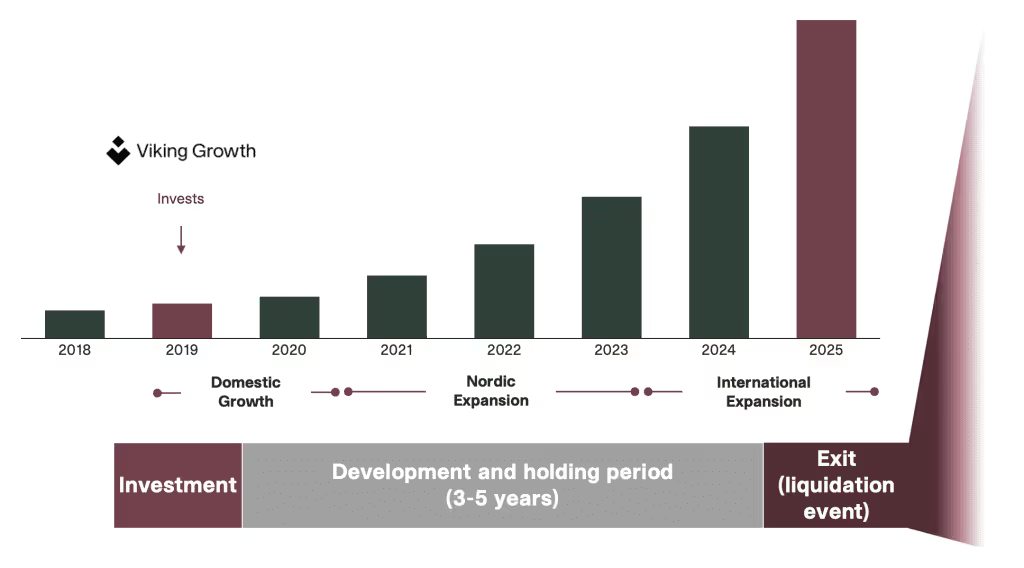
There are many ways a company can exit, but for the types of SaaS businesses we partner with, the three most common are going public, full exit, and majority recap. Below, we break down what each of these entails and share concrete examples from our own portfolio to illustrate how different exit paths can unfold in practice.
Taking the company public through an IPO is the most visible form of exit and the least common. It is typically relevant only for large, mature SaaS companies with:
An IPO is not only a liquidity event but also a strategic shift, where the company becomes accountable to public markets, gains access to larger pools of capital, and enhances its credibility with enterprise customers. However, it also comes with heavier regulatory requirements, transparency demands, and pressure for quarterly performance.
Examples of IPOs by Viking Growth:
All of these companies were also delisted and taken of the market through a public-to-private (P2P) process.
In a full exit, all shares are sold to an external buyer, often a strategic acquirer or a private equity firm. This is the most common scenario for mid-sized SaaS companies.
Typical buyers include:
Examples of Full Exits by Viking Growth
A majority recap allows founders and early investors to take money off the table while still re-investing and staying involved in the company’s next phase.
This commonly takes the form of a majority recap by a private equity firm or a strategic investor.
The quality of an exit ultimately depends on three main drivers: the company’s operational performance and core SaaS Key Performance Indicators (KPIs), the strategic fit with potential buyers in the investor ecosystem, and the broader macroeconomic environment. Together, these factors determine both the attractiveness of the company and the competitive tension that can be created in a sale process.
How strong your SaaS KPIs and overall performance are will largely determine your valuation at exit. To assess this, we use a valuation scorecard model that benchmarks a selection of your key metrics against best-in-class B2B SaaS companies. This provides a clear, data-driven picture of where you excel, where you lag behind, and what improvements will have the biggest impact on valuation multiples.
If you want to understand which KPIs matter most—and how you compare—you can explore our resources below:
📋 The top SaaS KPIs you need to track in 2025
🔗 Download our KPI benchmarking Excel Sheet

The valuation model helps us as investors to have a very clear view on the exit value, before entering the exit process.
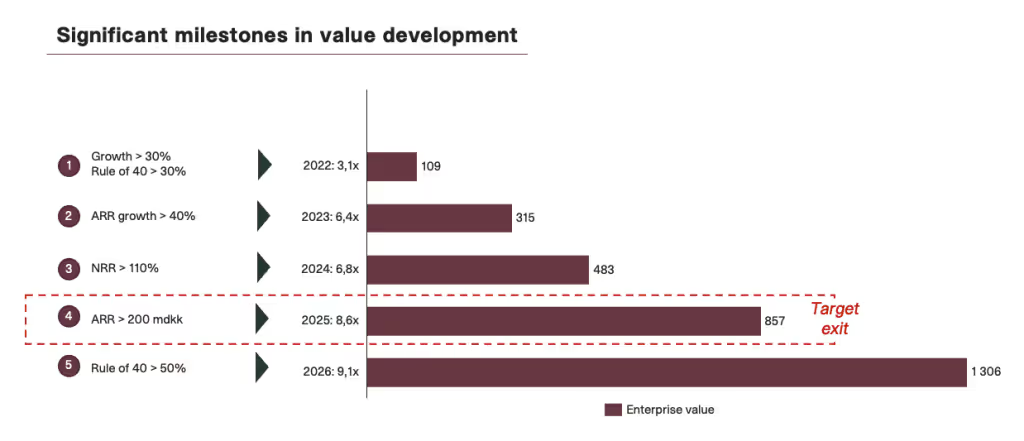
When assessing a potential acquisition, buyers evaluate a combination of quantitative performance indicators and qualitative strategic factors. The most common areas of focus include:
Total Addressable Market (TAM) and whitespace
Buyers want to understand the size of the opportunity ahead—how big the market is, how much remains untapped, and whether the company can grow into adjacent segments.
Core SaaS KPIs, cohorts, retention and pipeline health
Metrics such as net revenue retention (NRR), gross churn, Customer Acquisition Cost (CAC) payback, and cohort performance are central. Buyers also look closely at bookings, sales velocity, and pipeline coverage to validate future growth.
Annual Recurring Revenue (ARR) profile, bridges and product mix
Clear visibility on current ARR, how ARR has developed over time, and how it breaks down by product and customer segment is essential to understanding the company’s revenue quality.
Strategic synergy potential
Buyers evaluate how well the target fits into their strategy—product adjacency, technology leverage, customer overlap, and cost synergies. This “strategic synergy analysis” can be a major valuation driver.
Investor sentiment toward tech and SaaS investments is closely linked to the broader macroeconomic environment. Periods of high uncertainty, such as rising interest rates, slower Gross Domestic Product (GDP) growth, or tightening capital markets, tend to reduce risk appetite and place downward pressure on valuation multiples. To track these dynamics, we monitor both the Bessemer Venture Partners (BVP) Emerging Cloud Index and our own Nordic SaaS Index, which together provide a clear picture of how global and regional SaaS valuations are developing.
Looking at the valuation multiples in the market, we can observe how shifts in investor sentiment translate into changing expectations for growth, profitability, and capital efficiency. These trends directly influence exit timing, buyer interest, and overall attractiveness for mergers and acquisitions (M&A) or IPO scenarios.
📈 Follow the Viking Growth Nordic SaaS Index
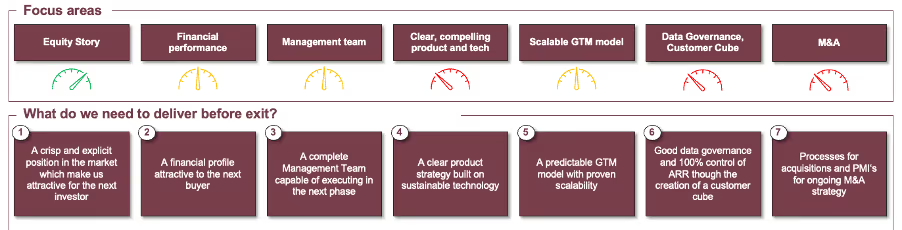
The Exit Readiness Scorecard is a framework our management teams use as an active tool to assess how well a company is positioned for a successful exit. It provides both a clear snapshot of the current state and a prioritized roadmap for what needs to be strengthened before going to market. The scorecard is built around seven key focus areas that together shape how attractive the company appears to potential buyers.
✅ Equity Story
Do we have a compelling and well-articulated growth plan for the next stage and owner? Is there a clear engagement strategy for potential buyers? We assess the clarity of the value proposition, ICP, industry and geographic focus, and whether we are a recognized market leader in the Nordics with a strong foothold in the EU.
📈 Financial Performance
Is there a complete and capable leadership team in place to lead the company through its next growth phase? Each key role should be clearly defined and filled with the right talent.
👥 Management Team
Is there a complete and capable leadership team in place to lead the company through its next growth phase? Each key role should be clearly defined and filled with the right talent.
🛠️ Product & Technology
Is the product strategy long-term and market-aligned, with efficient R&D investment (R&D cost/ARR < 20%)? Do we have a customer-centric product roadmap and scalable architecture.
🚀 Scalable Go-to-Market Model
How proven and efficient is the go-to-market engine?
📊 Data & Customer Cube
Is data governance in place to support decision-making and buyer confidence? This includes monthly reporting, full KPI dashboards, and a complete and up-to-date Customer Cube.
🤝 Mergers & Acquisitions (M&A) Readiness
Is M&A a part of the growth story, past and future? The scorecard assess whether:
A successful exit is always a joint effort that requires significant contribution from everyone involved. As investors, we typically lead the process in close collaboration with the management team and external advisors. In most cases, we partner with an investment bank or transaction advisor to ensure a well-structured, competitive process and to identify the most suitable buyers.
We have exited more than 30 companies and bring extensive experience in running well-structured exit processes, supported by a strong network of strategic and financial buyers in the B2B SaaS ecosystem. You can explore our previous exits and case studies here.

How do Nordic software companies scale globally? The Viking Growth newsletter shares actionable insights and strategies that show what really works.
Sign me up
Kongens gate 8, 7011 Trondheim
© Viking Growth 2025


.jpg)