

At Viking Growth, we have worked on pricing with our portfolio companies for years. The core principle has always been the same: price on the value you deliver, not on access.
What AI changes is not the principle, it is what drives the value, and how clearly you can measure and document it. Our 2026 framework — how to price software and AI on value in 2026 — sets out the broader value-based pricing playbook that this article extends into AI specifically. This article shares what we are observing, and how we are thinking about it as AI becomes a bigger part of what our portfolio companies build and sell.

Eivind Moseng, Investment Associate at Viking Growth
AI-powered products can have very different abilities, which affect how the solution should be priced.
As shown in the figure below, pricing progresses from users, to activity, to outputs, and finally to outcomes such as tasks completed or time saved. The closer pricing gets to measurable business results, the stronger the alignment with customer value and the greater the revenue potential, often increasing from capturing less than 10% of value to 10x or more.

As products become more advanced with AI, they take over more tasks, which makes outcome-based pricing more appealing. Autonomous AI agents act more like employees than regular tools. Charging per user for them is like charging for office chairs instead of the actual work done.
Bessemer Venture Partners have mapped three business model archetypes emerging in AI-native and AI-embedded software. We find this a useful starting point for thinking about where your product sits:
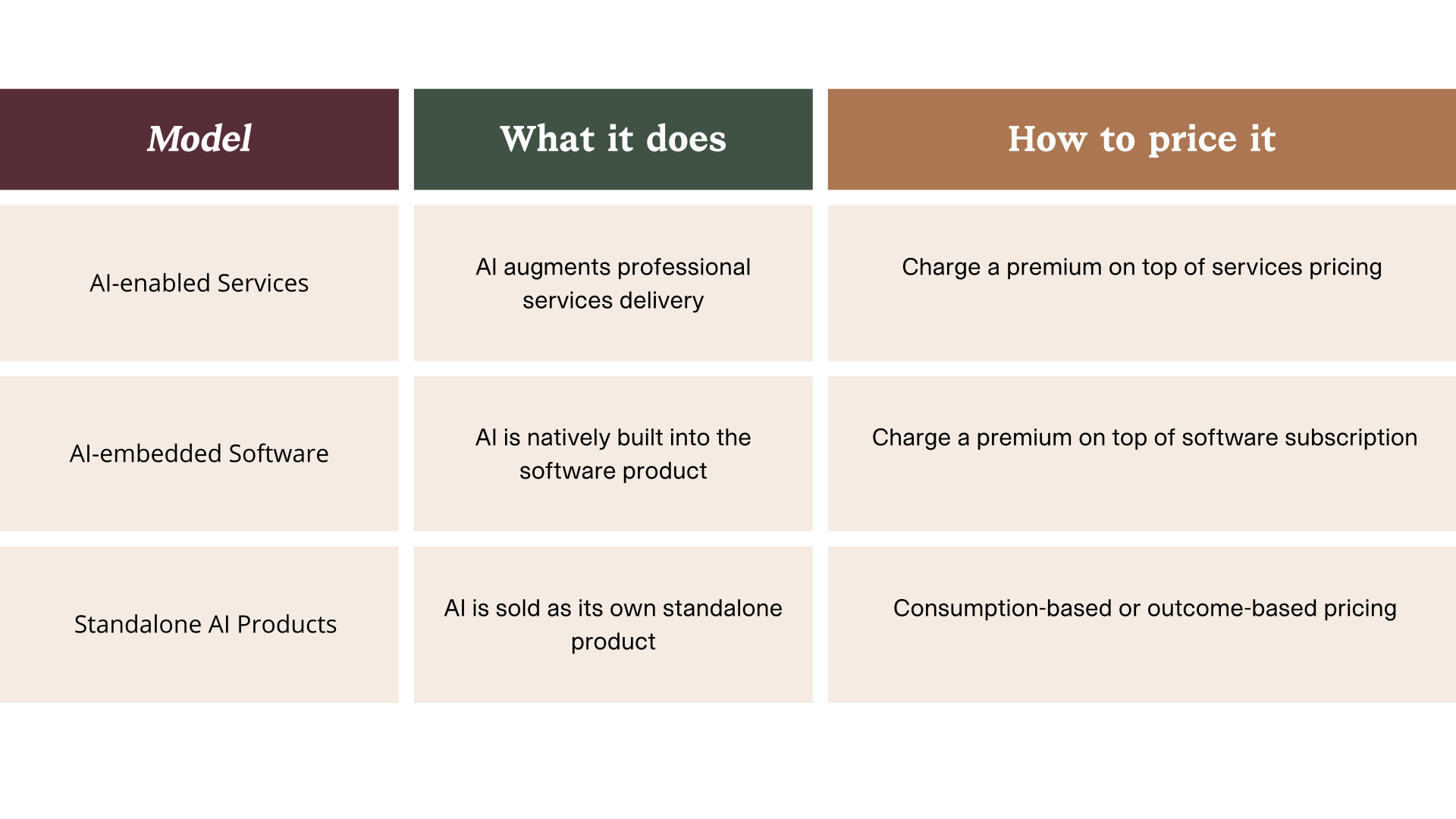
The first question to ask is which of these three categories your AI investment falls into. If AI is built into workflows, a higher subscription price makes sense. If the AI handles tasks or creates documents on its own, pricing per task or outcome is better.
Most AI pricing models use one of three main approaches to charging, each trying to balance predictable costs with the value delivered.
.svg)
A note on each metric
Consumption-based pricing works well for products aimed at developers, where usage is clear and easy to predict. For business buyers, unpredictable per-token charges can cause concern and delay buying decisions.
Workflow-based pricing is often a good fit for enterprise AI. It clearly shows the value, grows with usage, and uses metrics that customers can understand and plan for. The downside is that costs can vary more for vendors.
Outcome-based pricing usually leads customers to be willing to pay more and creates the best value match. But it needs reliable AI, measurable results, and clear agreements. It works best when it is easy to see how AI actions lead to business results.
The hybrid model is a strong place to start. Established B2B SaaS companies can use hybrid pricing by keeping a base subscription for steady revenue and adding a usage- or outcome-based fee for AI features. For example, you might charge a base fee plus a per-task cost for AI workflows, or offer a standard plan with an AI add-on priced by usage or results. These models help capture more value from AI, match pricing to customer benefits, and grow as AI use increases.
For the foundational frame that sits underneath all of this, see our guide to pricing model selection.
The core questions in value-based pricing have not changed. What value do you create? Revenue growth or cost savings? What ROI can you demonstrate? Incremental improvements or hard numbers? And how does your AI feature or product actually contribute to that? AI makes these questions more important, not different.
Here is what we are keeping front of mind as we work with our portfolio companies on pricing:
The fundamental question remains: what value are you creating, and are you capturing a fair share of it? If an AI agent does the work of three people, it should not cost the same as a single user licence. Start by quantifying the value, revenue gained or costs saved, and work back from there.
Track how you measure success. Instead of counting active users, track how much work is done by AI, how often AI solves problems, and how many tasks it automates. These numbers show if AI is adding value and should guide your pricing talks.
A base subscription gives both you and your customers predictability. Adding usage or outcome-based tiers lets you capture more value as AI use grows. Start by layering AI pricing onto the model you already have, you do not need to rebuild from scratch.
A base fee plus per-transaction charges is a familiar structure for most buyers, easy to explain in a sales conversation, and gives you room to grow as AI usage scales. Adjust as you learn.
Traditional B2B SaaS companies have high profit margins because their costs are mostly fixed. With AI, there are additional costs per token, call, or task, and these increase as usage grows. Your pricing needs to cover these costs as your volume increases, not just at average levels.
Before you set prices for AI features, work out the costs for each AI interaction. Many companies underestimate these costs when usage grows and end up with lower profit margins after a wide launch.
Meet buyers where they are. Align your model with what your customers are used to purchasing and be prepared that this may need to change over time. Remove friction. Unpredictable costs can slow deals down, especially when the CFO is involved. Therefore, make it simple to buy and easy to forecast. Your pricing and go-to-market plans should change together.
Teaching customers and the market about new pricing models takes time. Make sure to include this education in your launch plan and prepare your sales team to handle questions and explain the value clearly.
Before going to market with a new pricing model, ask honestly if your product can deliver on the way you are packaging and pricing it? This is especially important with AI, where performance gaps between what is promised and what is delivered can surface quickly.
The biggest resistance to pricing changes often comes from inside the organization. Involve sales and customer success early in the process. They will surface the real objections before your customers do.
Most Nordic software companies are just starting to include AI features in their product offering. This is a chance to set up asuitable pricing model from the beginning and avoid old models that do not reflect the true value AI can bring to your customers.
It is a mistake to wait until you fully understand AI’s value before charging for it. If you deliver real value but do not price for it, your margins will shrink. Think of your first pricing as a test that you will improve over time.
It is hard to know at first how much customers will use AI features or how much they are willing to pay for them. The market needs time to adjust to new pricing, so you will need real sales. Also, real sales conversations are the fastest way to find out. Pick a price, see how it works, and change it if needed. Treat pricing as a process you continually improve, just like you do with product development. Raise more than feels comfortable, sharp customer feedback tells you where the real ceiling is.
At Viking Growth, pricing is one of the first areas we work on with new portfolio companies and AI is making that work more urgent and more interesting. For the parallel view on how we apply AI itself across the portfolio, see how Viking Growth uses GenAI across its portfolio. We do not have all the answers yet, but we are learning fast alongside the companies we back. If you are working through these questions, we would like to hear how you are thinking about it.

Our pricing playbook has been updated to reflect recent AI-driven changes in how we deliver value and manage costs.
Download the pricing playbook!
Kongens gate 8, 7011 Trondheim
© Viking Growth 2025